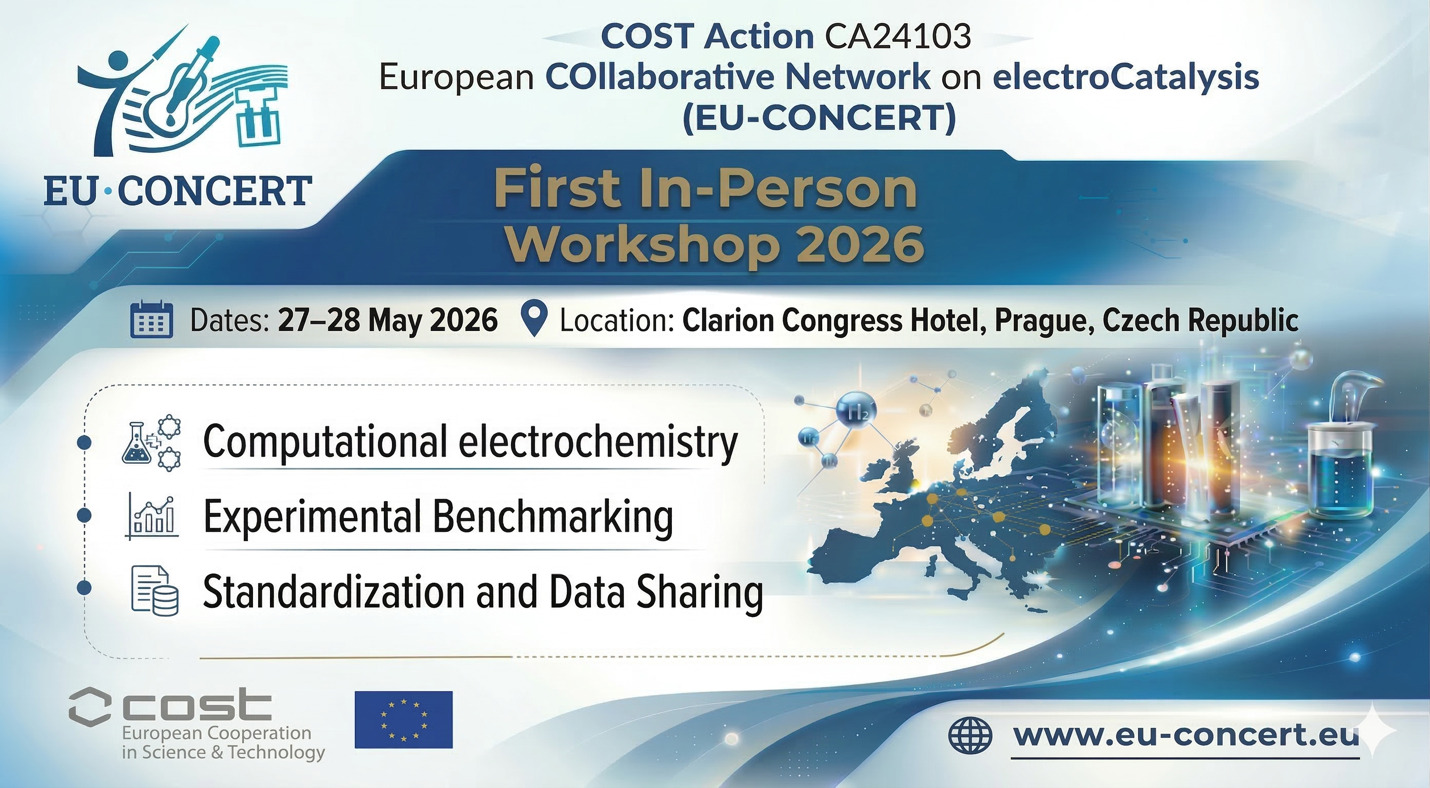
We are thrilled to look back at the First In-Person Workshop of the EU-CONCERT COST Action, which took place from 27–28 May 2026 at the Clarion Congress Hotel in Prague.
The event marked a major milestone for our network, bringing together more than 90 EU-CONCERT members from across Europe to foster face-to-face collaboration, share groundbreaking research, and drive the future of sustainable energy technologies.
Bridging Science and Innovation in Prague
Hosted by EU-CONCERT and seamlessly organized by Mrs. Klaudie Soukupova, Mrs. Katerina Minhova Macounova, and Prof. Eng. Petr Krtil of the J. Heyrovsky Institute of Physical Chemistry, the workshop served as an interactive platform to bridge fundamental science with applied technological development. After an extended period dominated by virtual interaction, the energy of in-person collaboration was palpable as researchers, innovators, and stakeholders joined forces.
EU-CONCERT (European Collaborative Network on Electrocatalysis for Efficient Renewable Technologies) remains dedicated to advancing research in electrocatalysis. This workshop directly supported our mission to accelerate progress in renewable energy systems, hydrogen production, fuel cells, and low-carbon energy futures.
Workshop Highlights & Key Sessions
The two-day program was packed with insightful introductions, invited talks, and collaborative working groups:
- Network Foundations & Rules: Action Chair G. Cicero opened the event with an introduction to EU-CONCERT, followed by Grant Holder Manager Ned Buijs detailing crucial COST rules.
- Working Group Insights: K. Doblhoff-Dier & G. Kastlunger mapped out the challenges in computational electrochemistry (WG1), while D. Strmcnik & Y. Grunder set the stage for experimental electrochemistry and benchmarking systems (WG2).
- Cutting-Edge Scientific Talks: Attendees benefited from world-class presentations by our invited speakers:
- D. Strmcnik and V. Komanicky introduced the relevance of studying single crystal system and what they can teach us about electrocatalysis
- Vanessa Bukas on predicting electrochemical energetics via explicit solvent modeling.
- Georg Kastlunger exploring the nuances of constant potential DFT.
- Rifael Z. Snitkoff-Sol on separating active site contributions to the hydrogen evolution reaction.
- Interactive Sessions & Brainstorming: Beyond lectures, the event featured lively poster sessions spanning three distinct groups and an intensive brainstorming session to define future breakout activities.
Shaping the Future: Group Work, Grants, and Dissemination
Day two shifted focus heavily onto hands-on cooperation. Dynamic breakout sessions allowed WG1 and WG2 to conduct collaborative group work and exchange ideas, while WG3 (Led by P. Pikma and L. Siinor) tackled the critical topics of Standardization and Data Sharing Practices.
Information on the grant evaluation process was shared by our Grant Awarding Coordinator, M. Re Fiorentin.
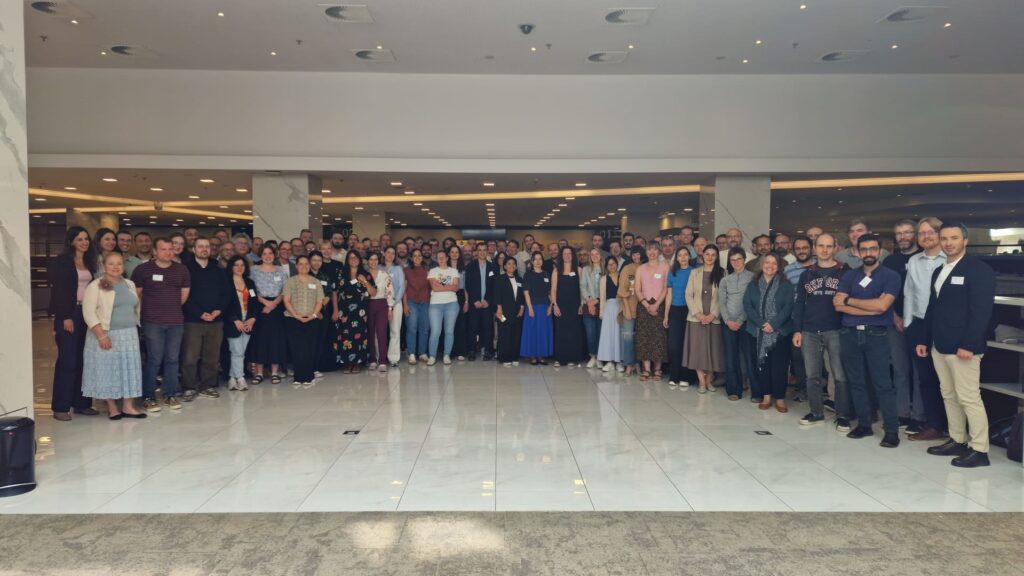
We also captured a memorable group photo session led by M. Lourenço (WG4 Leader) and E. Santos (Science Communication Coordinator), highlighting our commitment to strong communication and dissemination activities moving forward. The workshop concluded with a joint session synthesizing the valuable outcomes of the group work.
During the first day an in person Management Committee (MC) meeting took place to summarize achievements and discuss strategy plan for the forthcoming year.
Looking Ahead
Emphasis throughout the event was placed on supporting our Young Innovators and enhancing our network’s interdisciplinary collaboration. Prague proved to be the perfect hub for international scientific cooperation, providing an inspiring setting for the launch of our future activities.
A huge thank you to the organizers, speakers, and the 90+ participants who made this event an outstanding success! Let’s keep this collaborative momentum going.